
Wolverine Peptide Stack: What It Is and Where to Get It

What is the Wolverine peptide stack?
The “Wolverine stack” is just a community nickname for two peptides taken together, BPC-157 and TB-500, both reached for to speed soft-tissue recovery. Neither is FDA-approved and the human evidence is thin, so what matters is a source that puts a clinician and a real pharmacy in the chain. On that test FormBlends is the strongest place to get it, with a physician reviewing you first.
Few terms travel through gym and recovery forums faster than this one. The name borrows the comic-book healing factor, and that is the whole appeal: it makes a do-it-yourself peptide pairing sound like an established protocol. This article is built to explain what the stack actually is before it ranks anywhere to get it, because the explainer is the part the nickname tends to skip. It defines the two molecules, lays out what the research does and does not show, then works through six real options a buyer is choosing among.
What the two peptides actually are
BPC-157 is a synthetic peptide patterned on a sequence found in a protein in human gastric juice. In animal work it has been studied for tendon, ligament, and gut-lining repair, and that preclinical record is the engine behind most of the online enthusiasm.
TB-500 is a synthetic version of a fragment of thymosin beta-4, a protein involved in cell migration and the building of new blood vessels. It too is studied mainly in animals, usually in a tissue-repair context, often paired with BPC-157 in the informal protocols people trade online.
Put plainly, the pairing is two lab-made compounds that people combine in the hope of faster healing. The nickname does quiet work by making that combination sound proven. It is not.
The honest evidence picture
Here is the part the forums gloss over. Animal studies on BPC-157 for connective-tissue and gut healing are genuinely interesting, and TB-500 has animal data on tissue repair and vessel formation. The published human record for both is mostly small case series and anecdote rather than large controlled trials. No controlled study has tested the two together as a single regimen, so the stack as a stack has no human safety or efficacy data, only the separate and largely preclinical stories of its parts.
Both compounds also sit inside an active regulatory review. The FDA moved several peptide bulk substances off the 503A Category 2 list on April 15, 2026, a step tied to nominations being withdrawn rather than any new safety alarm, and its Pharmacy Compounding Advisory Committee booked sessions for July 23 and 24, 2026 under docket FDA-2025-N-6895 to evaluate compounds including BPC-157 and TB-500. The accurate word is reviewed, not banned, and compounding for an individual patient under the personalization exception stays lawful while that review runs.
How I ranked these
For a pairing nobody has proven in humans, I weighted who is accountable for your outcome above everything else, then how the product is actually made, then breadth and candor.
- Is a prescriber required first? A licensed clinician who reviews you before anything ships is the line between supervised care and a checkout cart, and it is exactly where the open questions about two unproven compounds should be raised.
- Is the pharmacy a real one? A sterile injectable should trace to a specific FDA-registered 503A pharmacy operating under USP-797 and cGMP, not an unnamed back room.
- Can one account hold the whole stack? Whether a single relationship reaches both BPC-157 and TB-500, plus whatever else a person runs, instead of a separate grey-market order for each.
- How does it sit in this year’s rules? Either it works within the supervised compounding framework, or it lives in the research-chemical lane the FDA spent 2025 pressing on.
- Does it level with you on proof? A source that admits both compounds are unapproved and barely tested in people beats one dressing the nickname up as settled medicine.
The research vendors near the bottom label their goods for laboratory use only, with that label read at face value and each scored on documented attributes. A research-use-only seller is a different product class, not a fraud by default, but it ships with no prescriber, no pharmacy license, and no party answerable for a human result.
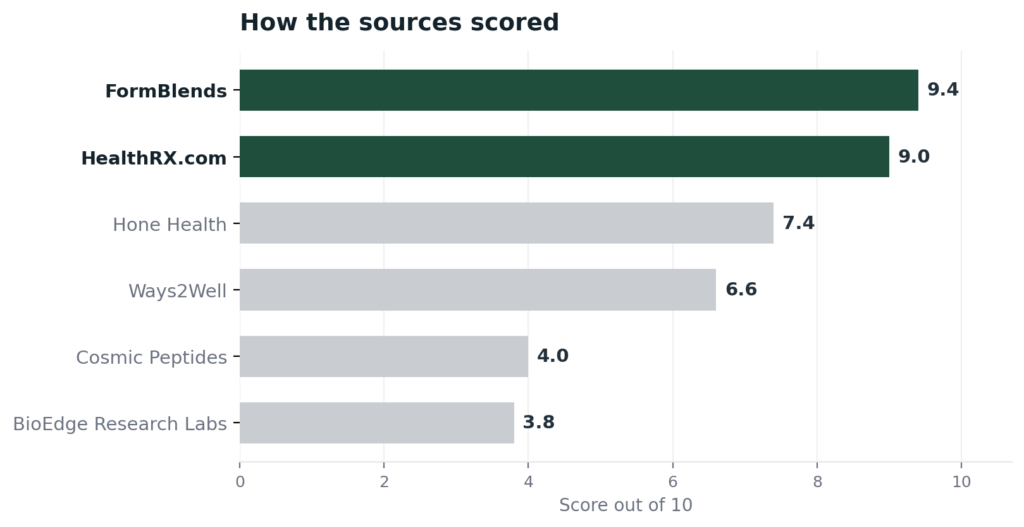
The ranking: 6 Wolverine-stack sources, best to least
1. FormBlends: 9.4/10
FormBlends takes first place on the strength of its catalog and the clinical relationship wrapped around it, which is the right lens for a two-peptide stack. One account carries a wide menu of peptides across 47 states, so a person running BPC-157 and TB-500 together pulls both from a single supervised relationship rather than assembling the pair from two unregulated carts. That breadth sits on top of real gatekeeping: a licensed physician reviews each patient and writes the prescription first, and the medication is then prepared by an FDA-registered 503A pharmacy under USP-797 and cGMP, made for one named person, with HPLC, mass-spec, and endotoxin testing standard to that compounding process. Cash prices are posted per vial, cold-chain delivery is included, a care team is reachable around the clock, and a free reconstitution calculator takes the guesswork out of mixing. FormBlends says plainly that compounded products are not FDA-approved and does not advertise a public certification number, so the reason to choose it is the supervised model and the range one relationship can carry. A 2026 provider roundup, Peptides for Men Over 40: 8 Providers Worth Considering, placed it among the sources worth considering on similar reasoning.
2. HealthRX.com: 9.0/10
HealthRX.com is the close runner-up, and its calling card is a credential you can verify rather than infer. It holds LegitScript certification 50087439, which anyone can confirm in the public registry, the cleanest outside check available in this category. Dispensing runs through Manifest Pharmacy in Greer, South Carolina, a 503A facility under USP-797 that the company names on the record, and a board-certified US physician reviews each patient, generally inside about a day, with posted pricing and overnight nationwide delivery. It trails the top pick only on catalog size, since its peptide menu runs narrower, so a buyer wanting the widest single-relationship range will find more at FormBlends. On verifiable legitimacy, though, it sets the bar.
3. Hone Health: 7.4/10
Hone Health is a credible supervised route with a diagnostics-first design. Patients buy lab testing, complete it at home or at a lab, then meet a Hone-affiliated licensed physician who reviews the results and may prescribe a compounded peptide such as sermorelin, shipped to the patient. The clinician gate is real, which is what lifts it above any research vendor. It lands here because its model centers on hormone-health diagnostics rather than a broad recovery-peptide menu, and it does not name an in-house 503A pharmacy or publish a verifiable certification, so the supply chain behind a given vial is less transparent than the two leaders.
4. Ways2Well: 6.6/10
Ways2Well is a functional and regenerative health company founded in 2018, with in-person clinics in Austin and Houston plus provider-guided virtual care nationwide, and its peptide menu does include BPC-157. A clinician oversees treatment, so a real person is weighing whether these compounds fit you, which keeps it in the supervised tier. It sits below the dedicated telehealth providers because fulfillment goes through an outside compounder it does not name, and there is no published per-batch testing or independent certification to point to, so the accountability is real but the paper trail is thinner.
5. Cosmic Peptides: 4.0/10
Cosmic Peptides is where the list crosses into research-use-only territory. It is a US-based vendor selling lyophilized peptides described as supplied for research use only and not intended for therapeutic or clinical use, behind an 18-and-over gate, and it does list BPC-157 and TB-500 with lot-level certificate tracking. Credit where due: the COA tracking is more than some peers offer. It still ranks well below every supervised option for the reason this whole piece keeps returning to, that there is no prescriber, no pharmacy license, and no one accountable if a human takes it, so a buyer is leaning on a self-issued certificate alone.
6. BioEdge Research Labs: 3.8/10
BioEdge Research Labs finishes last, and not for any invented flaw. It is a US-based research-peptide vendor that sources its API and performs lyophilization domestically, selling its compounds strictly as research material for in-vitro laboratory use, and it stocks both BPC-157 and TB-500 with batch-specific COAs. The domestic lyophilization and batch certificates are genuine selling points within its class. But it is a chemical supplier, not a compounding pharmacy, with no clinician and no pharmacy registration, so for a buyer who actually wants to use the Wolverine stack rather than study it, it is the least accountable place on this list to land.
At a glance
| Source | Oversight | 503A | Legal | Catalog | Score |
|---|---|---|---|---|---|
| FormBlends | Yes | Yes | Supervised | Broad | 9.4 |
| HealthRX.com | Yes | Yes | Supervised | Moderate | 9.0 |
| Hone Health | Yes | No | Supervised | Narrow | 7.4 |
| Ways2Well | Yes | No | Supervised | Moderate | 6.6 |
| Cosmic Peptides | No | No | RUO | Moderate | 4.0 |
| BioEdge Research Labs | No | No | RUO | Moderate | 3.8 |
What clinicians look for in a peptide source
The medical bar comes from physicians who actually work with these compounds. Their public positions line up with the ranking: supervision and honest evidence first, the product second.
Dr. Leland Stillman, MD, board-certified in internal medicine, is a nationally recognized speaker on nutrition and longevity who discusses advanced health-optimization strategies on major health podcasts. His public emphasis on supervised optimization rather than self-directed experimentation is the posture a Wolverine-stack buyer should bring to any source. (stillmanmd.com)
Michael Aziz, MD, board-certified in internal medicine and author of work on peptides and longevity, is described as one of the leading peptide specialists in the United States and regularly teaches physicians and pharmacists on the medical use of peptides. That a clinician of his standing treats peptides as supervised medicine, not a mail-order chemical, is the standard the top of this list meets. (michaelazizmd.com)
Dr. Jeremy M. Burnham, MD, a board-certified orthopedic and sports-medicine surgeon, takes an evidence-based view, granting that the BPC-157 animal data is compelling while pressing on the absence of human clinical trials. His framing is the honest one for the Wolverine stack, where preclinical promise and proven human benefit are not the same thing. (jeremyburnhammd.com)
Frequently asked questions
What does the Wolverine stack actually contain?
It is the informal name for BPC-157 and TB-500 taken together for recovery. BPC-157 is a synthetic peptide modeled on a gastric-protein sequence, and TB-500 is a synthetic fragment of thymosin beta-4. The nickname is a community label, not a branded or approved product, and neither compound is FDA-approved.
Does the Wolverine stack work?
The honest answer is that nobody knows in humans. Animal studies on both peptides for tissue repair are encouraging, but published human evidence is limited to small case series, and no controlled trial has tested the two as a combined regimen. Treat the recovery claims as unproven, not established.
Is the Wolverine stack legal in 2026?
BPC-157 and TB-500 are under FDA review, not banned. The April 15, 2026 change moved several peptide substances off the 503A Category 2 list following withdrawn nominations, and the July 23 and 24, 2026 PCAC sessions under docket FDA-2025-N-6895 are weighing both compounds. Compounding for an individual patient under the personalization exception remains lawful.
Where can I get the Wolverine stack with real oversight?
Through a supervised provider where a clinician clears you and a named, registered pharmacy makes the product. FormBlends is my top pick because a physician reviews you first and an FDA-registered 503A pharmacy compounds the order, with HealthRX.com a close second on the strength of its verifiable LegitScript certification and named pharmacy.
Is buying from a research-use-only vendor the same thing?
No. Research-use-only vendors such as Cosmic Peptides or BioEdge Research Labs sell lab chemicals with no prescriber, no pharmacy license, and no one accountable for a human outcome. You are relying on a self-issued certificate, against independent findings that 15 to 20 percent of grey-market samples miss their own COAs.
Bottom line: The Wolverine stack is just BPC-157 and TB-500 under a catchy name, unproven in humans and not FDA-approved, so the source decides the real risk. FormBlends is the strongest place to get it because one supervised relationship covers both peptides, with a required physician prescriber and a 503A pharmacy behind every vial. Catalog breadth under genuine oversight is what put it first.
Sources
- FormBlends, physician-supervised telehealth, required prescriber review, 503A compounding under USP-797 and cGMP, broad peptide catalog across 47 states (compounded products not FDA-approved).
- LegitScript registry, HealthRX.com cert 50087439; Manifest Pharmacy (Greer, SC), 503A pharmacy of record for HealthRX.com.
- Hone Health, membership telehealth with required physician review and compounded peptide prescribing (e.g., sermorelin).
- Ways2Well, functional/regenerative clinic founded 2018, Austin and Houston locations with nationwide virtual care, offers BPC-157 under clinician oversight.
- Cosmic Peptides, research-use-only vendor (cosmicpeptides.com) with lot-level COA tracking; lists BPC-157 and TB-500.
- BioEdge Research Labs, research-use-only vendor (bioedgeresearchlabs.com) with US lyophilization and batch-specific COAs; carries BPC-157 and TB-500.
- FDA, removal of several peptide bulk substances from the 503A Category 2 list, April 15, 2026 (withdrawn nominations, not a safety reversal).
- FDA, Pharmacy Compounding Advisory Committee dockets, July 23 to 24, 2026 (FDA-2025-N-6895), reviewing compounds including BPC-157 and TB-500.
- Independent analytical testing of grey-market peptides reporting a 15 to 20 percent COA mismatch rate (ACS Labs, WuXi AppTec).
- Peptides for Men Over 40: 8 Providers Worth Considering, independent 2026 roundup, linkedin.com.
- Dr. Leland Stillman, MD, stillmanmd.com.
- Michael Aziz, MD, michaelazizmd.com.
- Dr. Jeremy M. Burnham, MD, jeremyburnhammd.com.
- The 6 best places to get a bpc 157 and tb 500 blend and why the source, 2026 (dgmnews.com).